





Student Spotlight: Meet Finn, a Level 5 Animal Management student at University Centre Rotherham
Faces of University Centre Rotherham:
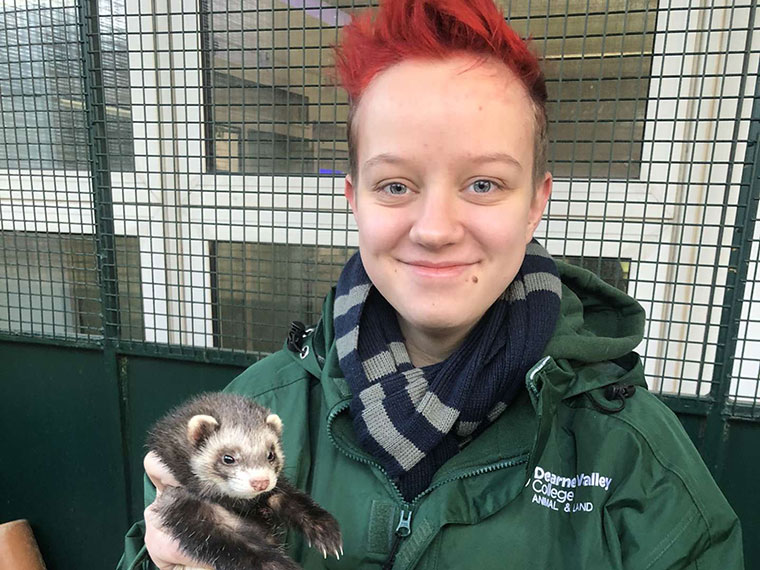
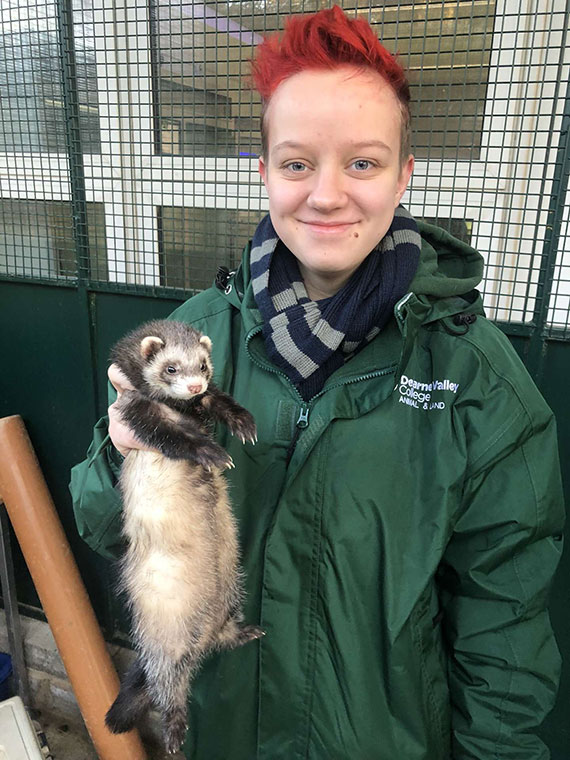
Finn Woodward, Higher National Diploma in Animal Management
Working in the zoo industry requires more than just a love of animals: it demands practical skills, resilience and specialist knowledge.
For 21-year-old Finn Woodward, studying the HND in Animal Management at University Centre Rotherham is providing exactly that, equipping them with the experience needed to pursue a career working with animals.
Finn’s journey into Higher Education
From an early age, Finn says they always knew they wanted to work in a zoo.
With an interest in animals, a junior ranger experience at Yorkshire Wildlife Park for a birthday treat sparked that ambition and has continued to shape their journey ever since.
“It made me realise I wanted to hang out with animals every day. Animals are better than people in general, aren’t they? I knew from then that I wanted to work in a zoo and it became a hyper-specific focus.”
After leaving school, Finn went on to sixth form to do A-levels in biology, geography and psychology with the aim of going on to university to study zoology.
Like most school leavers who are very academic, Finn had been encouraged to pursue the traditional route of Higher Education. However, having had their final school year disrupted by Covid, Finn says they found the transition from GCSE to A-level a challenge.
“I wasn’t clicking with A-levels. I was going through a lot at the time, on top of the academic stress of A-levels. All three A-levels had a lot of work and my grades were slipping, so I decided to look at other options out there.”
Rather than continuing down a route that didn’t feel right, they chose a more practical, vocational pathway, enrolling on the Level 3 Animal Management course at Dearne Valley College.
This decision allowed them to focus on hands-on learning and develop skills more closely aligned with their interests.
Successfully completing the Level 3 course gave them both the confidence and the foundation to progress onto Higher Education, continuing their studies in a way that works for them.
Finn“My advice would be to know that this is a valid alternative to university. It’s definitely becoming more of a mainstream option which has been good to see. It’s still hard work like uni is, but it’s allowed me to stay living at home and keep my part-time job which has helped with costs.”
Why Finn chose University Centre Rotherham
For Finn, choosing where to study was about finding the right environment to succeed. After their experience with A levels, they knew that a traditional university setting – with large lecture halls and less direct interaction – wouldn’t suit the way they learn best.
University Centre Rotherham’s smaller class sizes and more personalised approach to teaching stood out immediately. The ability to engage directly with tutors, receive one-to-one support and learn in a more interactive setting has helped them build confidence and stay engaged with their studies.
“I believe I wouldn’t have coped well at university with the environment where you feel like just another person in the room,” they explain. “I prefer the intimacy of the classroom environment where you can ask questions to a tutor who knows your name and not wait for two weeks for a professor to get back to you.”
Before enrolling, Finn hadn’t realised there was an alternative Higher Education pathway outside of the traditional degree route.
“I always thought it was either A-levels and then straight to university, or nothing,” they say. “At the time, I didn’t know about the level 4 HNC course or the level 5 HND until my tutor, Kazz, suggested it. I thought it sounded better than going off to uni and potentially repeating what happened at A-level.”
Discovering the vocational pathway in Animal Management opened up a route into Higher Education that felt far more suited to their strengths and career goals. The smaller class sizes, practical focus, and step-by-step progression gave them the confidence to continue studying.
“I liked the idea that if, after one year, I didn’t want to carry on then I could walk away with that qualification. Whereas if you go to university to do a three-year degree and you leave after a year, that year counts for nothing. With this route, you can choose to keep progressing year on year or leave and go into work. It opens up a lot of different doors that people might not consider.”
The benefits of doing a vocational route
While doing the level 3 course, Finn realised their interest lies mainly in animal husbandry – the day-to-day care, handling and management of animals – rather than research-based study.
A lot of zoology degrees focus on research and science, with any practical time spent in laboratories, which Finn says didn’t appeal to them.
Whereas HNC and HND pathway combines theoretical knowledge with practical experience in animal care, enclosure management, health monitoring and species-specific husbandry.
This balance allows students to build the skills required for careers in zoos, wildlife parks and conservation settings where attention to detail, routine and animal welfare are key.
In the HNC year, students cover modules such as health and welfare, ecological principles, anatomy and physiology, and endangered species conservation.
If they choose to progress onto the HND year, they look deeper into animal behaviour, focusing on biological principles, breeding and genetics, animal behavioural management and anthrozoology.
Working with a variety of animals has helped them understand behaviour, welfare needs and safe handling practices, preparing them for directly working with them.
“I think it’s really useful being able to apply the theory to practical. You can read about doing a health check all you want, but until you actually do one then nothing equates to getting that practical experience.”
Unique facilities
At University Centre Rotherham, the animal management course is taught up at our sister site Dearne Valley Campus where we have specialist animal care facilities with access to real animals, allowing students to gain hands-on experience as part of their course.
Our learners across further and Higher Education get to work with a range of exotic and domestic animals from skinks, porcupines, sugar gliders and meerkats to rabbits, guinea pigs, birds and mice.
“At HE level, the husbandry element is more independent as we’re given more trust and responsibility than at level 3. When the skink arrived, our group was some of the first students to interact with her, feed her and make her more comfortable around humans.”
There are areas for food preparation, temperature monitoring, medication administrating, enclosure cleaning and enrichment. We also have a large outdoor farm area with alpacas, goats and chickens.
Finn says one of their most enjoyable parts of the course was recently building enclosures for Ceecee the cornsnake and some of our leopard geckos.
“It was quite fun to get to do a bit of DIY in the afternoon and I learned how to use a drill to put it together and make holes for the cables and lighting.”
Developing higher level skills
While the course has a strong practical focus, Finn is keen to highlight that studying animal management at Higher Education level goes far beyond simply caring for animals.
Progressing from Level 3 to the HND has challenged them to think in a much deeper and more analytical way. Where earlier study focused on building foundational knowledge, the HND requires students to explore the reasoning behind that knowledge.
“At Level 3, you learn the basics, but in Higher Education you keep burrowing deeper into why and how. The quality of writing you have to produce is a big step as every other sentence needs a reference. I’ve definitely become a better researcher and writer, but also being critical of literature which is helpful in everyday life.”
Alongside this academic development, the course includes applied research tasks. For example, they have completed ethograms – structured observations of animal behaviour – using animals within their in-house animal care centre.
By combining hands-on experience with academic depth, the HND is equipping Finn with a well-rounded skillset to not only to care for animals, but to understand and assess their behaviour, welfare and needs at a professional level.
Looking ahead
After completing the HND this summer, Finn is planning to take a gap year before advancing onto a top-up year at Derby College to achieve the full BSc degree in animal management (zoo and wildlife).
On completing the top-up year, their goal is to seek a role within a zoo, working with their favourite animals like the polar bear.
“I’d love to work with carnivores as they’re just really cool animals, but so does everyone else. I also quite like hoofstock but I’d be happy to take any role on offer as there wouldn’t be a role I’d be disappointed in.”
Finn’s advice to future students
“My advice would be to know that this is a valid alternative to university. It’s definitely becoming more of a mainstream option which has been good to see.
“It’s still hard work like uni is, but it’s allowed me to stay living at home and keep my part-time job which has helped with costs. I’ve never been one for the uni culture so unless you want the aspect of moving away to live independently then there isn’t that much different.”
Find out more about Animal Management courses at University Centre Rotherham.